
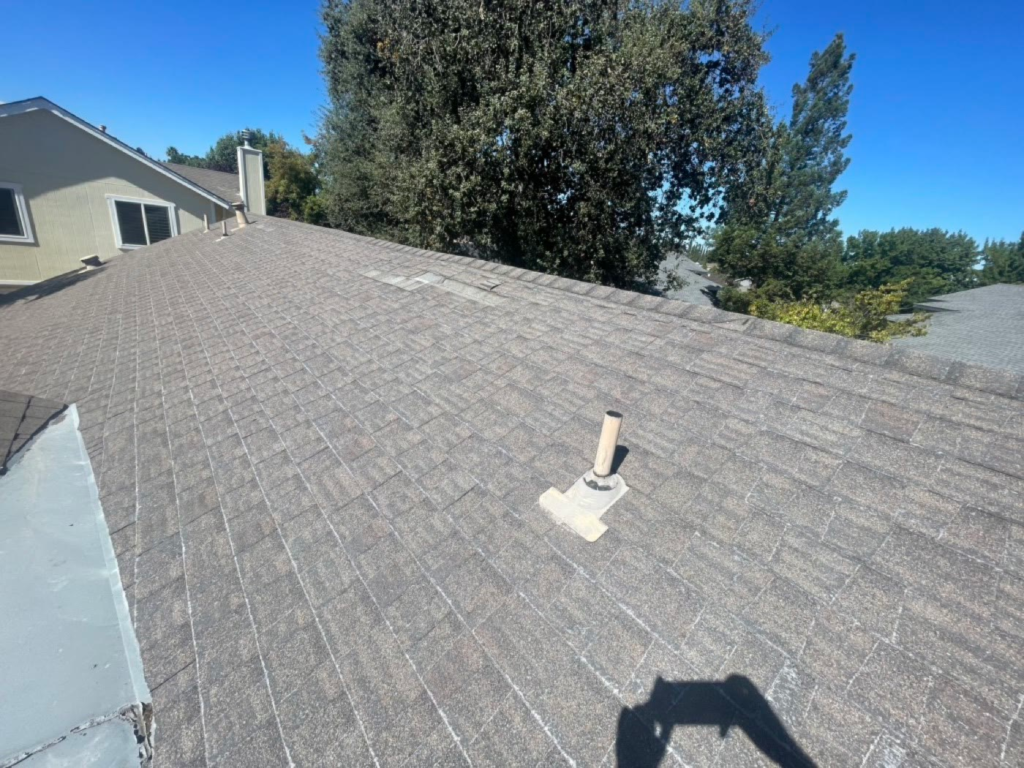
Short answer: For most Sacramento homes, we don’t recommend Roof Maxx. It is a spray treatment for asphalt shingles only, so it does nothing for a tile roof. Its warranty only promises the shingles stay flexible, and it says plainly that it does not cover leaks. If your roof is worn out or leaking, a repair or a new roof fixes the actual problem. A spray doesn’t.
We get a lot of calls from homeowners asking about Roof Maxx. Most of them have been told the spray will make their roof last at least five more years, and that it comes with a warranty. Wanting to save money on a roof is completely reasonable. But many of the roofs people ask about are already cracked, losing granules, and showing the fiberglass mat underneath, and in our experience no spray is going to bring a roof like that back.
When people call, we tell them it’s not something we do. Here’s why, along with what the product is and what its warranty really covers.
What is Roof Maxx?
Roof Maxx is a plant-based oil that’s sprayed onto an asphalt shingle roof. As shingles age in the sun, they dry out and get brittle. Roof Maxx says its treatment puts oils back into the shingles so they stay flexible, and that each treatment adds about five years to the roof’s life, up to 15 years with repeat treatments every five years.
Homeowners who call us say they’ve been quoted about $2,000 to $3,000 for a treatment. Roof Maxx doesn’t publish prices; each local dealer sets its own.
The five-year claims come from the company. The Asphalt Roofing Manufacturers Association, the trade group for the companies that make shingles, says there is “limited available documentation” that these treatments deliver the benefits they promise.
What the Roof Maxx warranty actually covers
The warranty is the main reason people call us, so it’s worth reading closely. According to Roof Maxx’s own warranty page:
| What people expect | What the warranty says |
|---|---|
| “My roof is covered for leaks” | It is not. The warranty says it is not a warranty against leaks, granule loss, or a badly installed roof. |
| “They’ll fix or replace my roof” | The remedy is re-spraying the affected area, prorated over five years. |
| “Storm damage is covered” | Wind, hail and similar damage are excluded and left to your homeowners insurance. |
| “It covers the whole roof” | It covers one thing: whether the treated shingles stay flexible for five years. |
In other words, if your roof leaks after a Roof Maxx treatment, the warranty doesn’t pay to fix the leak.
What shingle manufacturers say
The companies that make shingles are not fans of spraying anything on them after they’re installed.
- The Asphalt Roofing Manufacturers Association “strongly advises against” applying coatings or rejuvenators to installed asphalt shingles. Its bulletin says these products may affect the roof’s fire rating, algae resistance and impact resistance, and that many shingle manufacturers recommend against them.
- Owens Corning, the shingle brand we install, warns in its technical bulletin that these products can cause blistering, curling, or softening of the asphalt, and may affect the shingles’ fire rating.
In our own conversations with manufacturer representatives, including Owens Corning and GAF, they’ve told us they don’t recommend it. Our understanding from those conversations is that if your shingles still have an active manufacturer’s warranty, spraying them could put that warranty at risk, since it changes the roof from how it was made. That’s our experience, not an official policy, so if your roof still has a manufacturer’s warranty, call the manufacturer and ask before you sign anything.
It doesn’t work on tile roofs
Many Sacramento-area homes have concrete or clay tile roofs. Roof Maxx is made for asphalt shingles. On a tile roof, the part that wears out and causes leaks is the underlayment underneath the tile, and no spray on top can reach it. The fix for a worn-out tile roof is to lift the tile, put down new underlayment, and reinstall the tile. Learn about tile roof repair.
What we’ve seen and heard
Most homeowners who buy a treatment try to get their money’s worth out of it. They keep working with the same company and stretch the roof as long as they can, which can mean putting off a repair the roof already needed.
Public complaints show the same pattern. On Roof Maxx’s Better Business Bureau page, one homeowner wrote that their roof failed a home-sale inspection about seven months after treatment, and that the dealer agreed the roof “should not have been treated in the first place.” Roof Maxx refunded that customer. In another complaint, a homeowner had to replace the roof soon after treatment, and Roof Maxx cancelled the bill and accepted responsibility for an inadequate inspection.
When a spray won’t help
Even Roof Maxx says some roofs are too far gone. Its website says that if 30% or more of the protective granules are gone, the shingles are past the point of treatment, and that damaged roofs need repair or replacement. A spray won’t fix:
- Active leaks or water stains on your ceiling
- Missing, cracked or curling shingles
- Bad flashing around chimneys, vents or skylights
- Rotted or soft roof decking
- Worn-out underlayment on a tile roof
For a broader look, see roof restoration vs. roof replacement.
What we recommend instead
- Get the roof inspected first. Find out what’s actually wrong before you pay for anything.
- If the problem is in one area, repair it. A leak around a vent or a few broken shingles is usually a straightforward repair that costs far less than a new roof. See our roof repair services.
- If the roof is worn out, replace it. A new roof comes with a real manufacturer warranty on the materials and a workmanship warranty on the installation, covering far more than shingle flexibility. See what a new roof would cost, and look at financing if you need to spread it out.
Is there ever a good time for Roof Maxx?
Honestly, we’re not sure there is. If the product really does soften shingles, the time to do it would be while the roof is still in good shape, not after it already has cracks, granule loss and damage. But if a roof is in good shape, why spray it at all? Does it actually make the roof last longer? In our opinion, that hasn’t been proven yet.
Common questions
Does Roof Maxx fix leaks?
No. Its own warranty says it is not a warranty against leaks. A leak needs to be found and repaired.
Can Roof Maxx be used on a tile roof?
No. It’s made for asphalt shingles. Tile roofs leak when the underlayment under the tile wears out, and a spray can’t reach it.
Will Roof Maxx void my shingle warranty?
Roof Maxx says it won’t. The shingle manufacturers’ trade group strongly advises against these treatments, and Owens Corning warns about possible damage. Ask your shingle manufacturer directly before treating your roof.
Is Roof Maxx cheaper than a new roof?
Yes, up front. Homeowners tell us they’ve been quoted about $2,000 to $3,000. But it doesn’t fix existing damage, and the warranty only covers shingle flexibility. If the roof needs repair or replacement anyway, spending money on a treatment first can just delay the real fix.
Not sure what your roof needs?
Roof Recovery is a licensed and insured roofing contractor serving Sacramento, Roseville, Rocklin and nearby cities. We’ll inspect your roof, show you photos, and tell you honestly whether it needs a repair, a replacement, or nothing at all.
Book a free roof inspection or call (916) 678-9786.
Sources: Roof Maxx, Flexibility Warranty and roofmaxx.com; Asphalt Roofing Manufacturers Association, Application of Coatings or Rejuvenators on Asphalt Shingles After Installation (revised July 2026); Owens Corning, Technical Bulletin TB-10028163 (August 2026); Better Business Bureau, Roof Maxx Technologies complaints (viewed October 2026). Opinions in this article are Roof Recovery’s, based on our own experience. Roof Maxx is a trademark of its owner. Roof Recovery is not affiliated with Roof Maxx.


